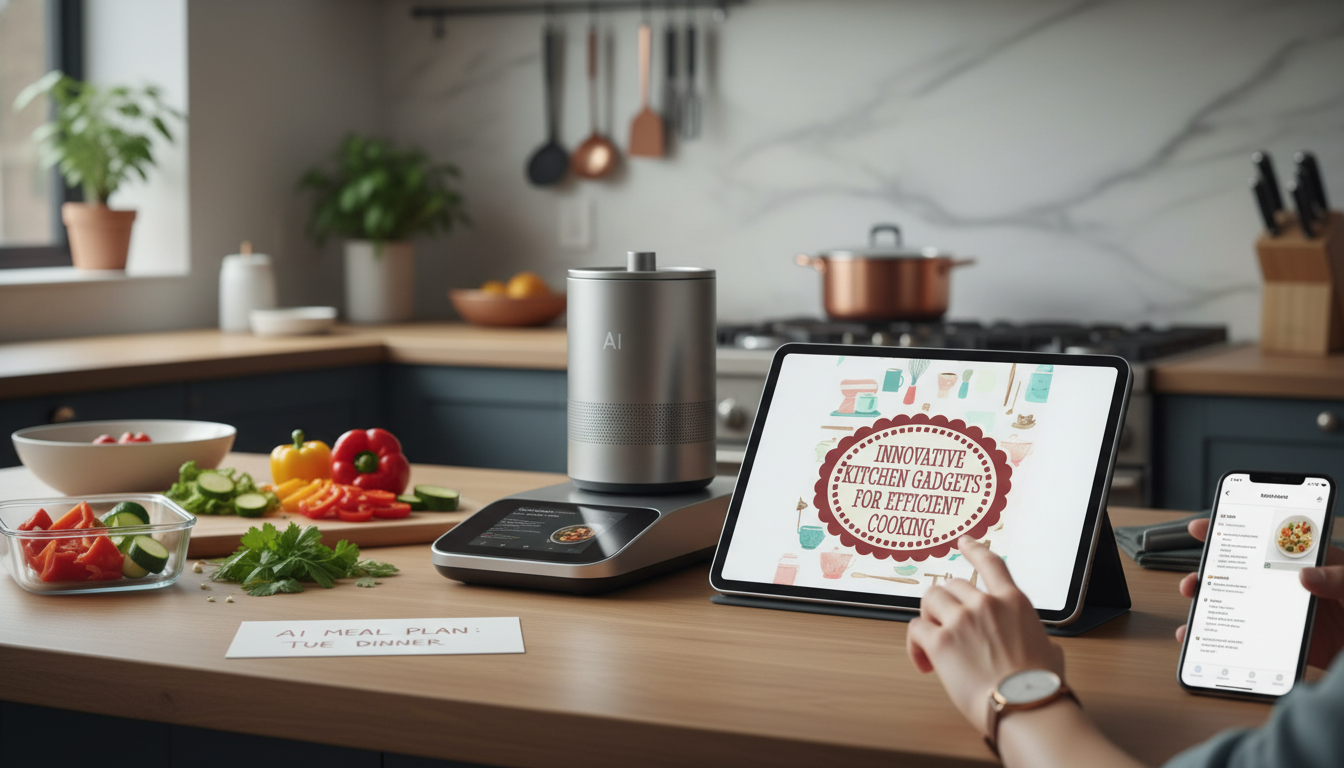
Efficient cooking isn’t about rushing—it’s about removing friction: fewer decisions, fewer steps, and fewer dishes. The fastest weeknight kitchens rely on a small set of repeatable routines, a few high-impact tools, and meal plans that reuse ingredients on purpose. Below is a practical, checklist-style approach to streamline prep, cooking, storage, and cleanup without sacrificing flavor or nutrition.
Efficiency comes from designing your kitchen time the way a good coffee shop designs a line: predictable steps, minimal backtracking, and fewer “what’s next?” moments.
The best gadgets aren’t the fanciest—they’re the ones that remove a repeated bottleneck. If most weeknights stall at chopping, prioritize prep tools. If proteins come out dry or undercooked, prioritize accuracy.
| Gadget | Where it saves time | Best for | Watch-outs |
|---|---|---|---|
| Food processor | Chopping/slicing/shredding in minutes | Big-batch veg prep, slaws, grated cheese | Takes storage space; wash parts promptly |
| Digital thermometer | No guesswork; fewer do-overs | Proteins cooked to safe, juicy temps | Needs quick wipe between checks |
| Multi-cooker | Hands-off cooking + batch portions | Beans, grains, braises, soups | Learning curve for timing/steam release |
| Air fryer/convection oven | Faster crisping than standard oven | Veg, wings, reheating leftovers | Capacity limits; avoid overcrowding |
| Kitchen scale | Fast, consistent measuring | Baking, portioning, meal prep macros | Battery replacement occasionally |
Two small upgrades that often outperform bigger appliances: sheet-pan liners (less scrubbing) and containers with labels (leftovers turn into planned lunches instead of mystery boxes). For protein safety and consistency, a thermometer is one of the simplest wins; the USDA’s guidance on proper thermometer use is a helpful reference for everyday cooking (USDA Food Thermometers).
AI helps most when it works inside clear boundaries. Instead of asking for “healthy dinners,” provide constraints that match real weeknights: time limit, tools, budget, and what’s already in the fridge.
For nutrition-forward planning without micromanaging every meal, Harvard’s Healthy Eating Plate is a simple visual that pairs well with component-style meal prep (Harvard T.H. Chan School of Public Health — Healthy Eating Plate).
When cooking feels chaotic, it’s usually because stations and timing aren’t defined. This flow keeps you moving in one direction.
| Task | Time | Result |
|---|---|---|
| Check pantry staples + frozen items | 3 min | Fewer midweek store runs |
| Plan 3 dinners with shared ingredients | 5 min | Simpler shopping list |
| Pre-wash greens or prep two vegetables | 5 min | Faster weeknight starts |
| Label containers + clear fridge front row | 2 min | Leftovers get eaten |
For food safety, prioritize fast cooling, covered storage, and consistent fridge temps; the FDA’s refrigeration guidance is a solid baseline for safer leftovers (FDA — Refrigeration and Food Safety).
If proteins are a frequent part of dinner, a digital instant-read thermometer typically saves the most time by preventing undercooking and overcooking. If chopping is your main bottleneck, a food processor is the fastest upgrade; for batch cooking, a multi-cooker wins when you want hands-off meals.
AI works best when you set constraints like “20 minutes,” “one pan,” and “use these 10 pantry staples,” then ask for a consolidated shopping list grouped by store section. You can also request leftover “remix” ideas so yesterday’s components become tonight’s dinner with minimal extra prep.
Once a week, pick three dinners that share ingredients, prep two vegetables, cook one base (like rice), and label leftovers for one planned remix meal. Keeping the routine to 15–30 minutes makes it easy to repeat and prevents midweek decision fatigue.









Leave a comment